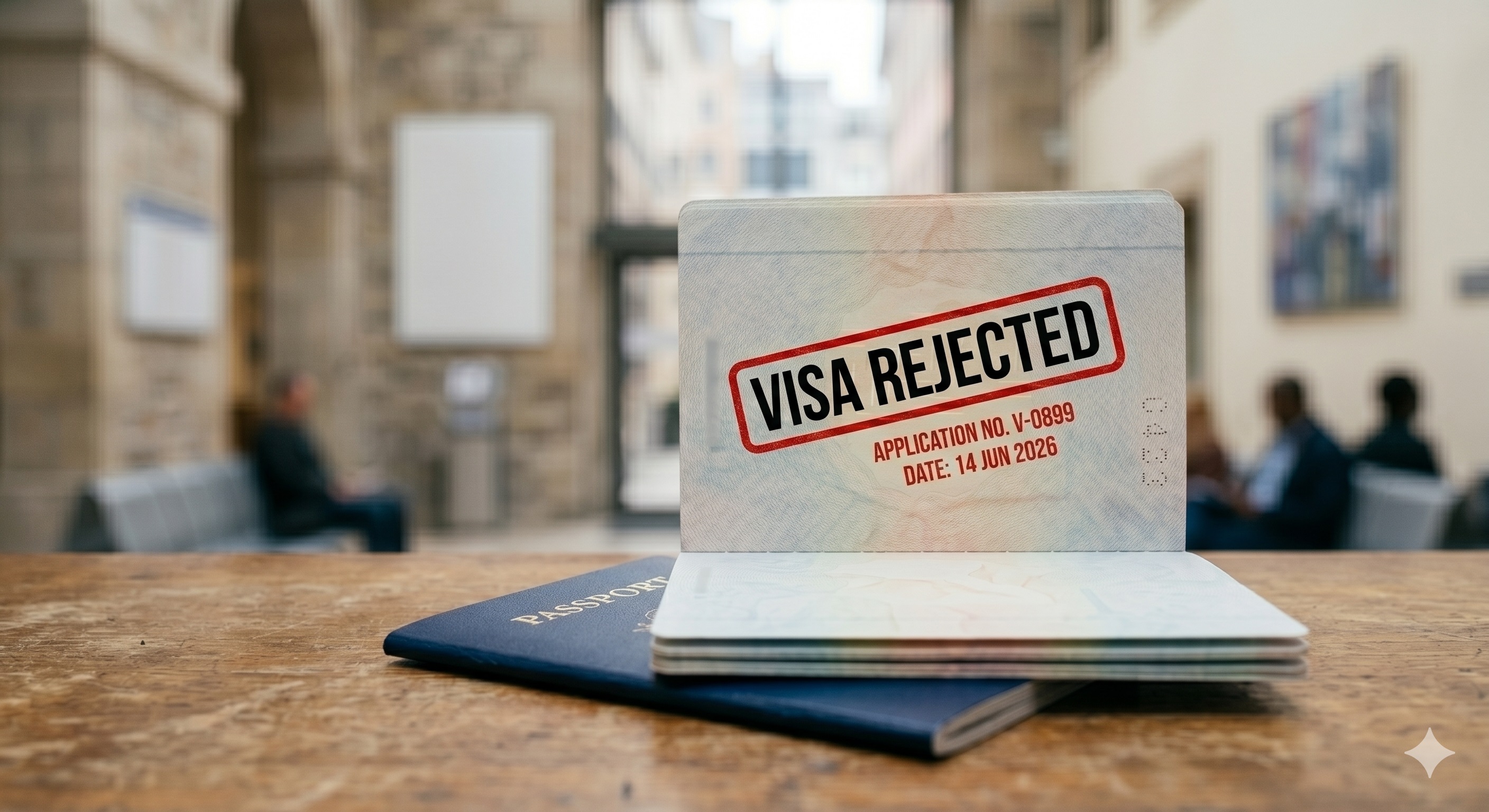
If you're reading this, you've probably just received an unwelcome email from the Cancillería, and you're trying to understand what went wrong. First, take a breath. A rejected Colombia digital nomad visa application is not the end of the road, and in many cases it's fixable. But you need to understand a few things the official notice probably didn't explain clearly: there are actually two different kinds of "rejection" under Colombian law, they have very different consequences, and the most common reasons in 2026 are not what most applicants assume.
Here's the honest landscape. The digital nomad visa was launched in 2022 as one of Latin America's most accessible nomad routes, with a low income bar and a simple promise. In 2025 the picture shifted. Reporting on the 2025 cycle puts approval at roughly 58% with about 42% of applications rejected, and that's against a backdrop of stricter scrutiny and increasing use of "discretionary authority" by visa officers. So if you got rejected, you're far from alone, and a lot of those rejections are about how the application was put together, not whether the applicant qualified.
This guide explains what your rejection actually means in legal terms, the most common real reasons applications fail, what to do next, and how to make the next attempt land.
This is general informational guidance, not legal or immigration advice. If you've been rejected, especially with a formal denial, consider consulting a qualified Colombian immigration attorney before reapplying.
First: What Kind of "Rejection" Did You Actually Get?
This matters more than anything else in this guide. Under Resolución 5477 de 2022, the master regulation governing Colombian visas, there are two distinct negative outcomes, and which one you received determines what you can do next.
Inadmisión (inadmissibility). Your application was not processed to a final decision. The Cancillería decided not to go forward, often because of documentation issues, missing requirements, or a discretionary call. The consequences are relatively mild: there's no waiting period before reapplying, and you can submit a new application immediately (from inside or outside Colombia).
Negación (denial). Your application was substantively reviewed and rejected, meaning the authority found you don't meet the core eligibility criteria. Consequences are heavier: you cannot file a new visa application for six (6) months, and you must apply from your country of nationality or permanent legal residence, not from inside Colombia. If you're currently in the country on a tourist permit, you generally have 30 calendar days to leave.
Look at your rejection notice carefully. The word that appears, inadmitida or negada, decides everything that comes next. Most digital nomad rejections in 2025–2026 are inadmissions, which is the better outcome.
The Article 19 Issue: "Discretionary Authority"
You may have noticed your notice cites the Cancillería's facultad discrecional, discretionary authority. This refers to Article 19 of Resolución 5477 de 2022, which formalizes that the State has discretion over who enters and stays in Colombian territory.
The frustrating practical consequence is that a discretionary inadmission may come with no detailed explanation, no specific document to fix, no clear "do X and you'll be approved." Even formal inquiries (a PQR or similar request for clarification) often receive the same vague response: the application was inadmitted under discretionary authority.
Worse, Resolución 5477 explicitly states that no administrative appeals (recursos) lie against decisions to inadmit or deny a visa. There is no formal mechanism to argue your case after the fact. The only real route forward is to fix the underlying problem and reapply, or to challenge the decision through a constitutional protection action (tutela), which is exceptional and requires a lawyer.
That sounds discouraging. But here's the important nuance: "discretionary authority" is often cited even when the real problem is something concrete and fixable in the application itself. Identifying the likely real cause is the first step to a successful reapplication.
The Real Reasons Digital Nomad Visas Get Rejected in 2026
Most rejections come back to one of the categories below. Read carefully, because the issue with your application is usually somewhere in here.
1. Income proof that doesn't hold up month by month
This is, by a wide margin, the most common technical reason. Colombia requires you to prove a monthly income of three times the legal minimum wage (3× SMMLV), which for 2026's COP 1,750,905 minimum wage is roughly COP 5,252,715 (~$1,400 USD) per month. But the rule that catches applicants out is this: there is no averaging. Every individual month must clear the threshold. If you had one strong month and one weak month, the weak month sinks the application.
Two more income traps are worth flagging. First, the Cancillería converts your foreign income to pesos using the exchange rate on the day they open your file, not the day you applied. A peso revaluation between filing and review can quietly push you under the threshold. Second, the standard proof is official bank statements, not invoices, not tax returns, not a letter from your accountant. Inconsistencies between your bank statements and the figures elsewhere in your application (your motivation letter, your employer letter) are a frequent killer.
2. Vague or insufficient proof of remote work
The visa requires you to prove you work for foreign clients or a foreign employer. A common failure is documentation that doesn't explicitly say so. An employment letter that doesn't state "remote" and "for a non-Colombian employer," contracts that don't clearly identify foreign clients, or freelance work described too loosely, all of these create doubt that the visa officer resolves against you.
Freelancers, in particular, have been getting extra scrutiny. If your activity is loosely defined ("digital marketing consultant," "online entrepreneur"), that vagueness can trigger an inadmission. Clearly technical or salaried profiles tend to do better than ambiguous freelance ones.
3. Document quality, format, and apostille problems
A huge share of rejections, some estimates suggest 20–30%, come down to documentation defects, not eligibility. The recurring problems:
- Missing apostille on foreign public documents (the Cancillería's Article 21 generally requires apostille or legalization for documents issued abroad).
- Documents not officially translated into Spanish, or translated by someone who isn't an authorized Colombian translator.
- Documents older than the allowed validity window (Article 20 of Resolución 5477 sets a three-month validity for supporting documents other than the passport).
- Illegible scans, low-resolution photos, wrong dimensions, files over the platform's size limit.
- A passport-style photo that doesn't meet the format rules (wrong size, wrong background, shadows, filters).
These are the most fixable of all the rejection reasons, and the most embarrassing to lose months over.
4. Health insurance that doesn't qualify
The visa requires all-risk health insurance valid in Colombia, covering accident, illness, maternity, disability, hospitalization, death, and repatriation, for the entire intended visa period. A generic travel-insurance policy does not qualify. Missing repatriation coverage in particular is a very common reason a policy gets rejected, even when the applicant otherwise qualifies. And because the policy has to cover the full visa period, short coverage can lead to either an outright rejection or a much shorter visa than expected.
5. Form errors and data inconsistencies
Article 16 of Resolución 5477 is blunt: any inaccuracy in the data you submit in the application form is grounds for inadmission or denial. Names spelled differently between documents, mismatched figures, wrong passport numbers, all of these can trigger a rejection. The Cancillería reviews your file looking for consistency, and inconsistency reads as either carelessness or worse.
6. The wrong-category problem
The digital nomad visa is specifically for remote workers earning foreign income as employees, freelancers, or digital-content/IT entrepreneurs. It is not the right visa for:
- Working with or for Colombian clients or employers (that requires a different visa).
- Traders or investors living off market returns (almost universally rejected under this category, the wrong fit).
- People who don't qualify under Resolución 5488 de 2022, the list of nationalities that don't need a short-stay visa to enter Colombia. If your passport requires an entry visa, you can't use the digital nomad route at all.
Applying under the wrong category can produce a rejection even when you'd qualify for a different visa entirely.
7. The vague "interest of the country" argument
You may see your notice reference your activity not being "of interest to the country." This argument is increasingly cited in 2025–2026 and, frankly, it's controversial. The text of Article 46 of Resolución 5477 lists "of interest to the country" specifically in connection with digital-content or IT entrepreneurship, not as a general filter for ordinary remote employees. When it's applied broadly, it can feel arbitrary, and a well-supported reapplication that clearly frames your work and intent can sometimes turn the outcome.
What To Do Next: A Practical Plan
Here's a step-by-step approach.
1. Read your rejection notice carefully. Find the exact word: inadmitida or negada. This sets your timeline and your next move.
2. Identify the most likely real reason. Map your case against the list above. Even if the notice cites only "discretionary authority," one of those concrete issues is usually the underlying cause. Be honest with yourself about which one applies, every income month at the threshold? Apostilles in place? Insurance with repatriation? No data mismatches?
3. If you were inadmitted (good news): you can reapply right away. But don't refile the same package, just press "send" with a fresh fee, and you'll get the same outcome. Diagnose the issue, fix the documentation, and then resubmit. Cumulative inadmissions can work against you over time, so do not waste attempts.
4. If you were denied: you must wait 6 months and apply from abroad. This is the time to bring in a qualified Colombian immigration attorney. If you're currently in Colombia on a tourist permit, plan to leave within the 30-day window. Staying past it creates an overstay problem that will haunt future applications.
5. Strengthen your reapplication systematically. This means:
- Show bank statements clearing the income threshold every single month, with a comfortable buffer above the line to absorb exchange-rate movement.
- Get an employer letter or client contracts that explicitly state the work is remote and the payer is foreign, ideally on company letterhead with full contact details.
- For freelancers, define your activity tightly and concretely; show contracts and consistent client payments.
- Re-pull every foreign public document so it's within the 3-month validity window, properly apostilled, and officially translated.
- Buy or upgrade health insurance that explicitly includes medical repatriation and covers your full intended visa period.
- Check every form field for consistency, names, IDs, addresses, figures, against every supporting document.
- Confirm the digital nomad visa is actually the right category for what you do.
- Write a clear motivation letter (in Spanish if you can) explaining your remote work and why Colombia, this matters more than people realize.
6. Consider professional help. Given that "discretionary authority" rejections come without explanation, an experienced Colombian immigration lawyer or specialist agency can be worth the cost, especially on a second attempt. They've seen many files and often spot the real issue quickly. After a denial especially, going it alone is risky.
7. Don't try to game the system. Repeatedly filing the same flawed application is the fastest way to accumulate inadmissions, build a worse record, and eventually convert a string of inadmissions into a flat denial.
What If The Visa Just Isn't Going to Work?
It's worth being honest: for some people, the digital nomad visa really isn't the right fit. If you're a trader or investor, look at the Investor (M) visa. If you have a Colombian spouse, partner, or child, the Migrant family route is usually faster and stronger. If your work involves Colombian clients, you need a work-authorized visa. If you're retired with passive income, the Pensionado (M) visa is the natural fit.
The right move after a digital nomad rejection isn't always to keep banging on the same door. Sometimes it's to walk through a different one.
Quick Checklist
- Inadmisión = no waiting period, can reapply now; Negación = 6-month wait, apply from your home country.
- There are no administrative appeals against an inadmission or denial under Resolución 5477.
- The most common real reasons: income inconsistency, vague remote-work proof, document/apostille defects, non-qualifying health insurance, data mismatches, wrong category.
- There is no income averaging, every month must clear 3× SMMLV (~COP 5.25M / ~$1,400 USD in 2026).
- The Cancillería uses the exchange rate on the day they review your file, apply with a buffer.
- Income proof must be official bank statements, consistent with everything else in your file.
- Foreign public documents need apostille + Spanish translation, and must be under 3 months old.
- Health insurance must be all-risk and include repatriation, for the full visa period.
- If denied, you have 30 calendar days to leave Colombia and must reapply from abroad in 6+ months.
- Don't refile a flawed application; diagnose, fix, and consider hiring a Colombian immigration attorney.
- If the digital nomad visa isn't the right fit, look at Investor, Pensionado, Migrant family, or work visas.
Final Thoughts
A Colombia digital nomad visa rejection feels personal, but in most cases it isn't. The 2025–2026 reality is a tougher review environment, increasing use of discretionary authority, and a high tolerance for sending back applications that have any meaningful flaw. The good news is that most rejections, especially inadmissions, are about how the application was put together, not whether the applicant qualified.
So treat the rejection as information, not a verdict. Figure out exactly what kind it was, identify the real underlying issue (often something concrete even if the notice was vague), strengthen the file methodically, and consider bringing in a Colombian immigration professional, particularly if you were formally denied. Many applicants who get rejected on the first try succeed cleanly on the second.
Colombia hasn't closed the door. It's just asking for a tighter, more careful application than the program's reputation once suggested. Put one together, and the door usually opens.
Need Help With Your Digital Nomad Visa?
Whether you're applying for the first time, reapplying after a rejection, or need to explore a different visa route entirely, Stanford Baker & Associates can guide you through the process.
Learn about the Digital Nomad Visa