
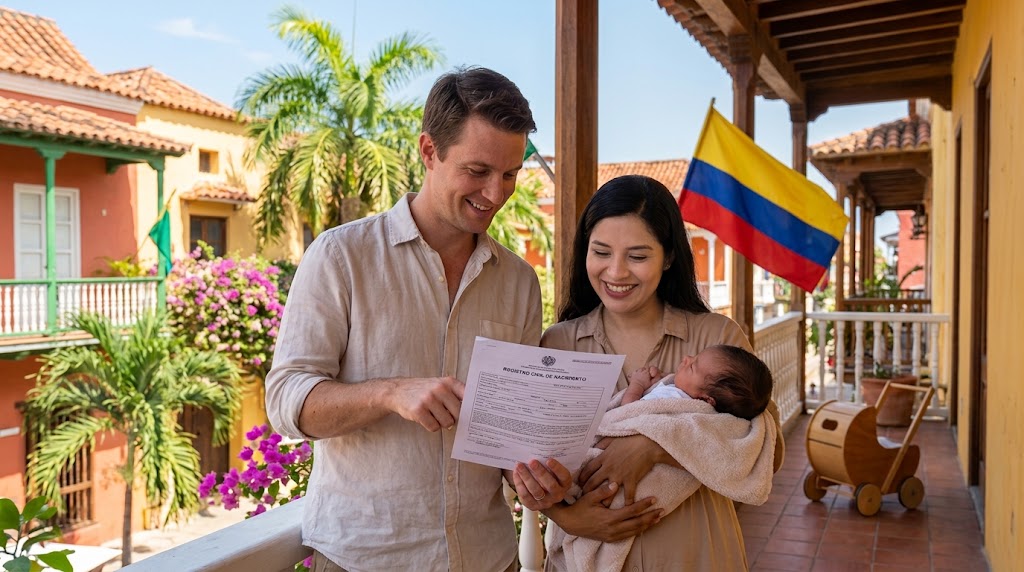
At Stanford Baker & Associates, we consistently work with expat couples who have just had a baby in Colombia and arrive at our office facing a fundamental misunderstanding: they assumed their child automatically received Colombian citizenship because the child was born on Colombian soil. Foreign parents from the United States are particularly prone to this assumption because US law provides birthright citizenship (jus soli) to virtually anyone born on US territory. Parents from other countries make similar assumptions based on their home country frameworks. The Colombian reality is different — and understanding that reality from the moment of birth (ideally before) prevents complications that can affect your child's legal status for years.
The honest reality this guide addresses: Colombia is primarily a jus sanguinis (nationality by blood) country, not a jus soli (nationality by birthplace) country. Under Article 96 of the Colombian Constitution, a child born in Colombia to two foreign nationals does NOT automatically receive Colombian nationality — unless at least one parent was legally domiciled in Colombia at the time of birth. And "domiciled" has a specific legal meaning: it requires regular migration status, meaning a Colombian visa (typically Migrant M or Resident R type) or Colombian cédula de extranjería. Tourist status does NOT qualify as domicile, which is a critical distinction that catches many foreign parents by surprise when they've been staying in Colombia on tourist stamps or PIP permits during the pregnancy.
For expat couples navigating this situation, understanding both sides of the birth registration process is essential: the Colombian side (registering the birth through the Registraduría Nacional del Estado Civil or a Notaría, obtaining the Colombian registro civil de nacimiento) AND the home country consular side (registering the child with your embassy or consulate for foreign nationality documentation, whether that's a US CRBA, UK consular birth registration, Canadian proof of citizenship, or Spanish consular registration). These processes should typically happen in parallel, and coordination between them affects your child's documentation for international travel, education, healthcare, and future citizenship options.
This guide covers the complete 2026 framework for expat couples registering their Colombian-born child: the Colombian nationality framework (Article 96 Constitution, Ley 43 de 1993, Ley 2332 de 2023 on dual nationality, Decreto 1260 de 1970 on civil registry), the critical domicile requirement (what qualifies, what doesn't, tourist status doesn't count, visa types that qualify), the Colombian birth registration process (documentation required, where to register, timeline, verification by Registraduría), what documents your child receives (Colombian registro civil de nacimiento with or without "Válido para demostrar nacionalidad" designation, cédula de extranjería if not Colombian), the parallel consular registration for major home countries (US CRBA framework at Embassy Bogotá and Consular Agency Barranquilla, UK consular procedures, Canadian proof of citizenship, Spanish consular registration, other EU countries, Australia, Latin American countries), special situations (unmarried parents, single parent, same-sex parents, surrogate births, assisted reproduction), retroactive registration options if initially registered without Colombian nationality, the alternative pathway of nationality by adoption if domicile requirement never met, common mistakes expat parents make, and comprehensive strategies for successful dual registration.
This is general informational guidance, not legal advice. Colombian nationality law and consular registration procedures are complex and highly fact-specific. Individual situations require specific legal analysis. For any actual birth registration matter, work with our team or another qualified Colombian immigration and family law attorney.
The 30-Second Answer
If you're an expat couple who just had a baby in Colombia in 2026:
The critical nationality framework:
- Colombia is primarily jus sanguinis (nationality by blood)
- NOT primarily jus soli (nationality by birthplace)
- Article 96 Colombian Constitution governs
- Two requirements for Colombian nationality by birth:
- Born in Colombia AND at least one parent is Colombian, OR
- Born in Colombia AND at least one parent is DOMICILED in Colombia at time of birth
What "domiciled" means legally:
- Requires regular migration status
- Visa M (Migrant) qualifies
- Visa R (Resident) qualifies
- Cédula de Extranjería demonstrates domicile
- TOURIST STATUS DOES NOT QUALIFY
- PIP/tourist stamp DOES NOT qualify
- DNV (Digital Nomad Visa) — complex, verify with counsel
Critical implication:
- If both parents on tourist status, child NOT Colombian by birth
- If one parent has M or R visa, child IS Colombian by birth
- Documentation of visa status at time of birth essential
The legal framework:
- Article 96 Colombian Constitution — nationality by birth
- Ley 43 de 1993 Articles 4 and 5 — implementation
- Ley 2332 de 2023 Article 34 — dual nationality permitted
- Decreto 1260 de 1970 — civil registry framework
- Circular Única de la Registraduría Nacional — practical guidance
Colombian birth registration:
- Where: Registraduría Especial, Municipal Registraduría, or any Notaría
- When: Within 30 days ideally (later possible)
- Cost: Free
- Documents required: Medical birth certificate, parents' identification, blood type
What child receives:
If Colombian by birth (parent domiciled):
- Registro civil de nacimiento with "Válido para demostrar nacionalidad" designation
- Later: Tarjeta de identidad (7-17 years) or Cédula de ciudadanía (18+)
- Colombian passport eligible
If NOT Colombian by birth (no parent domiciled):
- Registro civil de nacimiento (as record of birth in Colombia)
- NO Colombian nationality
- Foreign passport through consulate
- Cédula de extranjería if remaining in Colombia
Parallel consular registration for home countries:
United States (CRBA):
- Consular Report of Birth Abroad
- US Embassy Bogotá or Consular Agency Barranquilla
- Cost: $100 USD (CRBA) + $135 USD (passport)
- Processing: 6-12 weeks typical
- Electronic application (eCRBA) through MyTravelGov
United Kingdom:
- Consular birth registration
- British Embassy Bogotá
- Different documentation requirements
- UK passport application separate
Canada:
- Proof of Canadian Citizenship application
- Not a consular registration but citizenship proof
- Through Canadian Embassy
Spain:
- Consular registration
- Spanish Embassy Bogotá or Cartagena consulate
- Streamlined for children of Spanish parents
Other EU countries:
- Variable procedures
- All follow general framework
- Each country's specific requirements
Retroactive registration options:
- If parent later becomes domiciled in Colombia, child can be registered as Colombian by birth
- Must prove new domicile status at time of registration
- Alternative: Colombian nationality by adoption after 5 years legal residence
Understanding the Colombian Nationality Framework
The most important thing to understand before your child is born (or immediately after) is Colombia's specific nationality framework.
Article 96 of the Constitution
The complete Article 96 provisions on nationality by birth:
a) Colombians by birth include:
- Naturales de Colombia (born in Colombian territory) with one of two conditions:
- At least one parent is Colombian (jus sanguinis), OR
- If both parents are foreigners, at least one is DOMICILED in Colombia at time of birth
b) Also Colombians by birth:
- Children of Colombian parents born abroad who later become domiciled in Colombia or are registered at a Colombian consular office
The Two-Track Framework
Track 1: Jus Sanguinis (Nationality by Blood)
- At least one Colombian parent
- Automatic for child born anywhere
- Registration process establishes documentation
Track 2: Jus Soli with Domicile Requirement
- Both parents foreign
- Born in Colombia
- At least one parent must be domiciled
- Domicile is the key requirement
For expat couples:
- Both foreign nationals
- Track 2 is the only pathway
- Domicile requirement is critical
What "Domicile" Means in Colombian Law
"Domiciliado" (domiciled) has a specific legal meaning:
Requires regular migration status:
- Colombian visa demonstrating intent to stay
- Cédula de extranjería demonstrating registration
- Formal recognition of residency intent
Visa types that qualify as domicile:
- Visa M (Migrant) — all M category visas
- Visa R (Resident) — all R category visas
- Colombian citizenship (obviously)
Visa/status that does NOT qualify:
- Tourist status (PIP) — explicitly does not qualify
- V (Visitor) visas — generally do not qualify (visits without residence intent)
- Overstayed status — does not qualify
- No documentation — does not qualify
The DNV (Digital Nomad Visa) question:
- Technically V-category visa (visitor)
- Case-by-case analysis for domicile
- Not clearly settled in all jurisdictions
- Consult qualified counsel for specific analysis
Legal Framework Supporting Article 96
Ley 43 de 1993 Articles 4 and 5:
- Implementation of Article 96
- Definitions and procedures
- Documentation requirements
Decreto 1260 de 1970:
- Civil registry framework
- Birth registration procedures
- Standards for documentation
Ley 2332 de 2023 Article 34:
- Dual nationality permitted
- Colombians don't lose nationality by acquiring another
- Recent modernization of framework
Circular Única de la Registraduría Nacional:
- Practical guidance for registrars
- Verification procedures
- Documentation standards
The Critical Domicile Requirement in Practice
Understanding the domicile requirement's practical application clarifies your situation.
Documentation Registrars Verify
Registrars will verify:
- Parent's visa type or permit
- Corroborates constitutional domicile requirement
- Reviews cédula de extranjería status
- Applies Circular Única guidance
Scenarios and Outcomes
Scenario 1: Both parents on tourist status
- Neither domiciled
- Child NOT Colombian by birth
- Only receives foreign nationality through consulate
- Registro civil records birth in Colombia
Scenario 2: One parent on M-visa
- One parent domiciled
- Child IS Colombian by birth
- Registro civil "Válido para demostrar nacionalidad"
- Can obtain Colombian passport
Scenario 3: One parent with cédula de extranjería
- Parent domiciled
- Child IS Colombian by birth
- Full Colombian nationality documentation
Scenario 4: Both parents R visa (residents)
- Both parents domiciled
- Child clearly Colombian by birth
- Straightforward registration
Scenario 5: Recently arrived, applying for visa
- Not yet domiciled at time of birth
- Child NOT Colombian by birth at registration
- Retroactive registration possible if domicile later established
The Timing Issue
Domicile status at TIME OF BIRTH matters:
- Not at time of registration
- Not at any other time
- Specifically the moment of birth
Documentation should reflect:
- Visa/status held at birth
- Recent cédula (if applicable)
- Evidence of continuous domicile through birth date
If You Realize You Don't Meet Domicile Requirement
Options if child born without qualifying parent domicile:
Option 1: Register as foreign national
- Registro civil de nacimiento without "Válido para nacionalidad"
- Foreign passport through consulate
- Cédula de extranjería in Colombia
- Wait for domicile to be established
Option 2: Delay full Colombian registration
- One parent obtains visa establishing domicile
- Then register birth with new domicile documentation
- Colombian nationality by birth possible
Option 3: Pursue nationality by adoption later
- 5 years legal residence for child
- Formal naturalization process
- Different framework
The Colombian Birth Registration Process
Regardless of whether nationality is granted, birth registration in Colombia is important.
Where to Register
Options:
- Registraduría Especial — special offices in major cities
- Municipal Registraduría — every municipality has one
- Any Notaría — notaries can register births
- Colombian consulate abroad — for Colombians born outside Colombia (not applicable here)
Choose based on:
- Convenience of location
- Wait times at specific offices
- Preferred procedure
When to Register
Recommended timeline:
- Within 30 days of birth ideal
- Later registration possible but requires additional documentation
- For births after significant delay: declaration by witnesses may be needed
Later registration considerations:
- Original registration always preferred
- Court process may be needed for very late registration
- Additional documentation and witnesses
Required Documentation
Universal requirements:
Certificado de Nacido Vivo (Medical Birth Certificate):
- Issued by hospital/clinic where birth occurred
- Documents live birth
- Contains medical information
- Original required for registration
Alternative if no certificate:
- Declaration by two adult Colombian witnesses
- Under oath
- Direct knowledge of birth
Blood type documentation:
- Required for the person being registered
- From medical records typically
- Registered on civil registry
Parents' identification:
- Cédula de ciudadanía if Colombian
- Cédula de extranjería if foreign
- Passport if no cédula yet
- Both parents' identification when possible
For foreign parents specifically:
- Copy of visa (to verify domicile if applicable)
- Cédula de extranjería copy
- Passport copy
- Proof of continuing residence in Colombia
Marriage certificate (if married):
- Not strictly required per Registraduría
- But often requested in practice
- If from abroad, needs apostille and translation
The Registration Process Step-by-Step
Step 1: Gather Documentation
- All required documents ready
- Copies of parents' identification
- Medical certificate
- Visa/domicile documentation if applicable
Step 2: Choose Location
- Registraduría or Notaría
- Verify hours and requirements
- May not need appointment
Step 3: Visit With Documentation
- Both parents ideally present
- Or one parent with sufficient documentation
- Or through power of attorney if necessary
Step 4: Registrar Verification
- Reviews all documentation
- Verifies visa/domicile status
- Confirms constitutional requirements
- Determines nationality attribution
Step 5: Registration
- Formal act of registration
- Both parents sign if present
- Witnesses if required
Step 6: Registro Civil Issued
- Multiple certified copies typically requested
- Free at time of registration
- Additional copies later have small fees
What the Registro Civil Contains
Standard information:
- Full name of child
- Date of birth
- Time of birth
- Place of birth (city, department, country)
- Names of parents
- Nationalities of parents
- Cédula/identification of parents
- Blood type
- Registration date and location
Critical notation for nationality:
- "Válido para demostrar nacionalidad" — indicates Colombian nationality by birth
- Absence of this notation means Colombian nationality NOT established by birth
- This distinction is fundamental for future documentation
Colombian Documentation Timeline After Registration
Immediate:
- Registro civil de nacimiento available
- Multiple certified copies
Age 7:
- Tarjeta de identidad (blue) available if Colombian
- First identification card
Age 14:
- Tarjeta de identidad (yellow) — updated version
- Same purposes
Age 18:
- Cédula de ciudadanía — adult identification
- Full citizen documentation
Any age:
- Colombian passport if Colombian nationality established
- Can obtain for international travel
Consular Registration for Home Countries
Simultaneous consular registration is typically essential.
United States: Consular Report of Birth Abroad (CRBA)
The CRBA framework:
- Consular Report of Birth Abroad
- Official evidence of U.S. citizenship for children born abroad to U.S. citizen parent(s)
- Must apply before child's 18th birthday
- Recommended promptly after birth
Where to apply in Colombia:
- U.S. Embassy Bogotá
- Consular Agency Barranquilla
- eCRBA electronic application through MyTravelGov
Fees (2026):
- CRBA: $100 USD
- First U.S. passport: $135 USD (recommended simultaneously)
- Total typical: $235 USD
Processing time:
- Clean cases: 6-12 weeks from application
- Complex cases: 3-4 months or longer
- Recommended: apply early
Documents required:
- Child's Colombian registro civil de nacimiento
- U.S. citizen parent's evidence of citizenship
- Evidence of U.S. citizen parent's physical presence in U.S. (critical requirement)
- Marriage certificate of parents (if applicable)
- U.S. citizen parent's passport
Physical presence requirement (critical):
- U.S. citizen parent must have specific years of physical presence in U.S. before child's birth
- Requirements vary by parent's citizenship acquisition
- Well-documented physical presence essential
- Common cause of complications
Simultaneous passport application:
- Strongly recommended
- CRBA is not a travel document
- Passport enables travel to U.S.
- Combined appointment possible
Key challenges:
- Physical presence documentation often problematic
- Unmarried parent situations more complex
- Documentation coordination essential
United Kingdom
British consular birth registration:
Where to apply:
- British Embassy Bogotá
- Online application process
Fees:
- Consular birth registration: approximately £150
- UK passport separately
Processing:
- Timeline: variable, weeks typical
- Documentation similar to other systems
Documents required:
- Child's Colombian birth certificate (apostilled)
- British parent's evidence of citizenship
- Marriage certificate
- Physical presence documentation
British citizenship requirements:
- British parent must be British citizen
- Certain restrictions on transmission
- Otherwise-than-by-descent complications
Canada
Framework:
- Proof of Canadian Citizenship application (not consular registration)
- Through Canadian Embassy Bogotá
- Or via Immigration, Refugees and Citizenship Canada
Documents:
- Child's Colombian birth certificate
- Canadian parent's citizenship evidence
- Marriage certificate
- Physical presence documentation if applicable
Processing:
- 6-12 months typical
- Certificate of Citizenship issued
- Passport can be applied for after
Spain
Spanish consular registration:
- Consulado General de España in Bogotá or Cartagena
- Consular birth registration (Registro Civil Consular)
Documents:
- Colombian birth certificate
- Spanish parent's DNI/passport
- Marriage certificate
- Physical presence documentation
Advantages:
- Streamlined for Spanish parents
- Direct pathway to Spanish citizenship
- EU citizenship implications
Other EU Countries
General framework:
- Each country has specific consular procedures
- Similar documentation requirements
- Contact specific embassy/consulate
Common EU countries with Colombian expats:
- Germany: Deutsche Botschaft Bogotá
- France: Ambassade de France Bogotá
- Italy: Ambasciata d'Italia Bogotá
- Netherlands: Netherlands Embassy Bogotá
Australia and New Zealand
Australian citizenship by descent:
- Application through Department of Home Affairs
- Australian Embassy Bogotá coordinates
- Documentation similar to other Commonwealth systems
New Zealand:
- Similar framework
- NZ Embassy coordinates
Latin American Countries
Various frameworks:
- Country-specific consular procedures
- Regional integration considerations
- Contact specific consulate
Common Latin American parents of children born in Colombia:
- Venezuela: Special humanitarian frameworks
- Argentina, Chile, Mexico: Standard consular procedures
- Peru, Ecuador: Standard consular procedures
What Documents Your Child Receives
Understanding the documentation picture clarifies your child's status.
If Colombian by Birth (Parent Domiciled)
Colombian documents:
- Registro civil de nacimiento with "Válido para demostrar nacionalidad"
- Tarjeta de identidad at age 7 (blue), 14 (yellow)
- Cédula de ciudadanía at age 18
- Colombian passport available any age
Foreign country documents (through consular process):
- Foreign country's citizenship documentation
- Foreign passport
- Foreign identification if applicable
Result: Dual (or multiple) nationality
- Colombian + Home country citizenships
- Fully permitted under Ley 2332 de 2023
- Both passports valid
If NOT Colombian by Birth
Colombian documents:
- Registro civil de nacimiento (records birth in Colombia)
- NO Colombian nationality
- NO Colombian passport eligibility
Foreign country documents (through consular process):
- Home country nationality documentation
- Foreign passport
- Primary identification
Colombian residence documentation:
- Cédula de extranjería if remaining in Colombia
- Visa (beneficiario) depending on parents' status
Result: Foreign national living in Colombia
- Home country citizenship only
- Colombian residence permit
- May pursue Colombian nationality later through domicile establishment or naturalization
Special Situations
Unmarried Parents
Legal considerations:
- Both parents can be listed on birth certificate
- Paternity can be acknowledged voluntarily at registration
- If unacknowledged, can be established later
For nationality purposes:
- Domicile requirement of either parent suffices
- Both parents' nationalities can be transmitted
Single Parent
Registration by single parent:
- Mother's registration typically primary
- Father optional if establishing paternity
- Domicile of registering parent determines nationality status
Same-Sex Parents
Colombian recognition:
- Same-sex couples fully recognized
- Both parents can be registered on birth certificate
- Same nationality transmission rules apply
For nationality:
- Domicile of either parent qualifies
- Same as opposite-sex couples
Surrogate Births
Complex legal territory:
- Colombian surrogacy law framework
- Registration considerations complex
- Legal counsel essential
- Cross-border implications significant
Assisted Reproduction
Modern reproductive medicine considerations:
- Registration based on legal parents
- Documentation of assisted reproduction if relevant
- Similar framework to natural births
Adoption
Different from birth registration:
- Adoption is separate legal process
- Adopted children receive different documentation
- Special considerations for international adoption
Retroactive Registration and Later Options
If initial registration didn't include Colombian nationality, later options exist.
Retroactive Colombian Nationality
When parent later becomes domiciled:
- After original registration, parent obtains M or R visa
- Or obtains cédula de extranjería
- Can request update/re-registration to establish Colombian nationality
Documentation needed:
- Original registro civil
- Evidence of parent's current domicile
- Formal request for update
Legal analysis needed:
- Constitutional requirement was domicile at time of birth
- Some interpretations allow later establishment
- Consult qualified counsel for specific analysis
Nationality by Adoption (Naturalization)
Alternative pathway when domicile requirement not met:
Requirements:
- Child has 5 years legal residence in Colombia
- Legal residence typically through visa or cédula de extranjería
- Formal application to Cancillería
- Different from birth-based nationality
Advantages:
- Provides Colombian nationality
- Same rights as nationality by birth for most purposes
- Path when domicile requirement not met
Process:
- Requires 5-year legal residence
- Formal Cancillería application
- Various requirements
Common Mistakes We See
In our practice, expat parents consistently make the same mistakes.
Mistake 1: Assuming Automatic Colombian Citizenship
The mistake: Believing birth in Colombia automatically grants Colombian nationality.
Consequence: Registration doesn't grant nationality; complications with future documentation.
Prevention: Understand Article 96 framework before birth.
Mistake 2: Not Understanding Domicile Requirement
The mistake: Not realizing tourist status doesn't qualify as domicile.
Consequence: Child not Colombian by birth despite parents' presence in Colombia.
Prevention: Verify domicile status well before birth; obtain proper visa if desired.
Mistake 3: Delaying Registration
The mistake: Waiting weeks or months to register birth.
Consequence: Increased documentation requirements; potential complications.
Prevention: Register within 30 days when possible.
Mistake 4: Missing Consular Registration
The mistake: Only registering with Colombia, not home country.
Consequence: Child not documented as home country national; travel and citizenship issues.
Prevention: Simultaneous or prompt consular registration.
Mistake 5: Poor Documentation of US Physical Presence
The mistake: US citizen parent lacks documented physical presence evidence.
Consequence: CRBA denied or delayed; child may not receive US citizenship.
Prevention: Comprehensive physical presence documentation before applying.
Mistake 6: Not Applying for Passports Simultaneously
The mistake: Getting nationality documents without applying for passports.
Consequence: Additional appointments needed; delays in travel capability.
Prevention: Combined applications when possible.
Mistake 7: Not Coordinating Documents
The mistake: Inconsistent names or details across Colombian and foreign documentation.
Consequence: Documentation problems, potential future complications.
Prevention: Careful coordination and consistency.
Mistake 8: Ignoring Visa Implications
The mistake: Not considering how child's status affects family's overall visa strategy.
Consequence: Suboptimal immigration positioning.
Prevention: Integrated visa planning.
Mistake 9: Not Getting Blood Type on Certificate
The mistake: Forgetting to obtain blood type documentation.
Consequence: Incomplete registration; may need supplemental process.
Prevention: Request blood typing at hospital.
Mistake 10: DIY When Complex Situations Exist
The mistake: Handling complex situations without qualified counsel.
Consequence: Preventable mistakes with long-term consequences.
Prevention: Qualified legal support for complex cases.
Quick Checklist
- Article 96 Constitution governs Colombian nationality by birth.
- Two parents foreign = child NOT automatically Colombian.
- Domicile requirement: At least one parent must be domiciled at time of birth.
- Domicile = regular migration status (M or R visa, or cédula de extranjería).
- Tourist status DOES NOT qualify as domicile.
- Register within 30 days at Registraduría or Notaría.
- Documents needed: Medical certificate, parents' IDs, blood type, visa/domicile proof.
- Registration is FREE at Colombian government offices.
- "Válido para demostrar nacionalidad" notation indicates Colombian nationality.
- Parallel consular registration with home country embassy essential.
- US CRBA process: $100 + $135 for passport, 6-12 weeks typical.
- Dual nationality permitted under Ley 2332 de 2023.
- Retroactive registration possible if parent becomes domiciled later.
- Naturalization alternative after 5 years legal residence.
- Qualified counsel valuable for complex situations.
Why Stanford Baker & Associates for Birth Registration Matters
Birth registration for expat couples in Colombia combines Colombian nationality law with home country citizenship coordination and often ongoing immigration planning. Our practice at Stanford Baker & Associates provides comprehensive support throughout this critical process.
Comprehensive services relevant to birth registration:
- Family Law Services — comprehensive family law representation
- Immigration Services — for related immigration matters
- Colombian Citizenship — for citizenship matters
- Marriage Visa — for parent visa matters if applicable
Services specifically for birth registration:
- Pre-birth planning consultation — establishing appropriate parent status
- Domicile verification — confirming Article 96 requirements
- Documentation preparation — comprehensive documentation
- Registraduría coordination — Colombian side registration
- Consular coordination — home country embassy/consulate
- CRBA support (for US parents) — coordination with US Embassy
- Cross-border coordination — with home country counsel
- Retroactive registration — for cases needing later update
- Naturalization coordination — if pursuing Colombian nationality later
- Immigration coordination — for family's overall visa situation
- Complex situations — unmarried parents, single parents, same-sex parents, surrogacy
Particularly valuable for:
- Expat couples expecting babies in Colombia
- Expat couples with recent births needing proper registration
- Couples with complex nationality situations
- US parents needing CRBA support
- Unmarried parents requiring paternity establishment
- Same-sex couples needing proper documentation
- Surrogacy or assisted reproduction cases
- Cases with domicile complications
- Retroactive nationality establishment
Founded by foreigners, for foreigners. We understand what expat parents face in Colombian birth registration.
Bilingual team. All advice, documentation, and communications in English (and Spanish).
National coverage. Legal services in Bogotá, Medellín, Cartagena, Cali, Barranquilla, Pereira, Manizales, Armenia, Santa Marta, Bucaramanga, Cúcuta, and Villavicencio.
Cross-border coordination. Regular work with foreign embassies and consulates.
Family-oriented approach. Birth registration is a family matter — we treat it with appropriate care.
Get Started with Our Team
If you're expecting a baby in Colombia or have recently had one and need guidance on proper registration, qualified legal counsel provides essential support for successful dual documentation.
Contact our team:
- WhatsApp: +57 321 864 2275
- Email: info@stanfordbaker.com
- Website: stanfordbaker.com
- Bogotá office: Kr 13 # 93-68, Bogotá, Cundinamarca, Colombia
We offer initial consultations to discuss your specific situation and provide clear fee structures.
Final Thoughts
Registering a Colombian-born child of foreign parents is a critical process that determines your child's nationality, documentation, and future legal status. The most important insight is that Colombia's nationality framework is fundamentally different from what most foreign parents expect — birth in Colombia does NOT automatically grant Colombian citizenship. Understanding Article 96's domicile requirement, coordinating between Colombian and home country registration, and planning documentation properly enables successful navigation of this important moment.
The most important insights to internalize are: Article 96 Colombian Constitution governs — birth in Colombia doesn't grant automatic citizenship; Domicile requirement essential — at least one parent must have regular migration status; Tourist status doesn't qualify — M or R visa, or cédula de extranjería required; Colombian registration free at Registraduría or Notaría; 30-day timeline ideal but later possible; "Válido para demostrar nacionalidad" notation indicates Colombian nationality; Parallel consular registration essential with home country; US CRBA framework for American parents ($235 total, 6-12 weeks); Dual nationality permitted under Ley 2332 de 2023; Retroactive registration possible if domicile established later; and Qualified counsel valuable for complex situations.
The practical realities that separate successful birth registrations from problematic ones are: Pre-birth planning ideally — establish domicile before birth if desired; Understanding your specific status and its nationality implications; Prompt registration in both Colombia and home country; Comprehensive documentation including physical presence evidence for US parents; Coordination between systems for consistency; Realistic expectations about processing times; Cross-border planning with home country counsel when needed; Ongoing legal support for related matters; and Family integration into overall immigration/citizenship strategy.
In our experience helping expat couples with birth registration in Colombia, the outcomes that work best combine understanding of the Colombian legal framework with practical coordination across systems. The parents who navigate this most successfully are those who understand Article 96 before or shortly after birth, plan appropriately, and work with qualified counsel to ensure proper dual registration.
For expat couples having babies in Colombia, our practical playbook is: Understand Article 96 framework ideally before birth; Verify parent domicile status relative to Colombian nationality requirements; Plan visa strategy if wanting Colombian nationality for child; Register in Colombia within 30 days at Registraduría or Notaría; Gather documentation comprehensively including medical certificate, IDs, visa proof, blood type; Coordinate consular registration with home country embassy simultaneously; Apply for passports when applying for nationality documentation; Address complex situations with qualified counsel; Plan for ongoing documentation as child grows; and Integrate with family's overall immigration and citizenship strategy.
Colombia offers a genuine pathway to Colombian nationality for children born there, but only when parents meet the domicile requirement. Understanding this framework and planning appropriately ensures your child receives the nationality documentation you want — whether that's Colombian nationality by birth, home country citizenship through consular process, or both through simultaneous registration. With proper preparation and professional support, expat couples can navigate this important moment successfully and establish strong documentation foundation for their child's future.
Contact our team: +57 321 864 2275 (WhatsApp) | info@stanfordbaker.com | stanfordbaker.com/family-law-services
Key official sources and references
- Article 96 Colombian Constitution — nationality by birth framework
- Ley 43 de 1993 Articles 4 and 5 — implementation
- Ley 2332 de 2023 Article 34 — dual nationality permitted
- Decreto 1260 de 1970 — civil registry framework
- Circular Única de la Registraduría Nacional — practical guidance
- Resolución 8470 de 2019 (Registraduría) — special framework for Venezuelan migrants
- Registraduría Nacional del Estado Civil: registraduria.gov.co
- Cancillería: cancilleria.gov.co
- U.S. Embassy Bogotá (CRBA): co.usembassy.gov/birth
- British Embassy Bogotá: gov.uk
- Canadian Embassy Bogotá: colombia.gc.ca
- Spanish Embassy Bogotá: exteriores.gob.es
- 2026 SMLMV: $1,750,905 COP
- Registro civil de nacimiento cost: FREE at Colombian offices
- US CRBA fee: $100 USD
- US passport for child: $135 USD
- Colombian registration timeline: Ideal within 30 days
- CRBA processing time: 6-12 weeks typical
This article is provided by Stanford Baker & Associates for general informational purposes only and is current as of early 2026. Colombian nationality law and consular registration procedures are complex. Individual situations require specific legal analysis. This is not legal or immigration advice. For any actual birth registration matter, work with our team or another qualified Colombian family law and immigration attorney.
Need Help Registering Your Child's Birth in Colombia?
Our team at Stanford Baker & Associates specializes in birth registration for expat families, with expertise in Colombian nationality law, consular coordination, and cross-border documentation strategies.
Schedule a Consultation